
Franklin County Court Records After Arrest
Franklin County court records after a jail arrest begin when the arrest moves from jail intake into a court filing. The Franklin County Sheriff's Office Booking Find tool can help identify a current inmate, current charges, case numbers, visitation location, and court dates. That is still a custody record. The court record is created and updated by the clerk and court systems after a complaint, ticket, indictment, bindover, plea, order, or disposition is filed.
The first court path depends on the charge. The Franklin County Municipal Court Criminal/Traffic Department processes misdemeanor criminal cases, traffic cases requiring appearances, payable traffic offenses, and new felony filings or preliminary stages. The Municipal Clerk notes that criminal and traffic arraignments are held Monday through Friday at 9:00 a.m., and Courtroom 4D handles in-jail defendants with criminal or traffic misdemeanors, new felony cases, or preliminary hearings. Felony cases later move into the Court of Common Pleas after bindover, indictment, or filing.
For the jail side of the same event, use Franklin County jail inmate records. For booking-photo questions, use the Franklin County jail mugshots page, because a court docket does not operate as a mugshot gallery.
Find Franklin County Court Records
Start with the court that fits the case stage. The Franklin County Municipal Court Clerk case search is the local route for misdemeanor, traffic, and early felony filing records. The search help says a search must include a case number, ticket number, both first and last name, or a company name. The most efficient searches use the case number or ticket number, which may appear on the sheriff roster when the person remains in jail.
For felony cases after indictment, bindover, or Common Pleas filing, use the Franklin County Clerk of Courts Case Information Online portal. CIO covers Common Pleas General Division criminal and civil cases, Domestic Relations cases, and 10th District Court of Appeals cases. It is a convenience copy, not the official court file, so questions about a certified or controlling record should be checked with the clerk's office or the official file.
The Municipal Court search page is shown in the image below. It is the first court portal many Franklin County users need after a jail arrest because it covers misdemeanor and new felony filing stages.
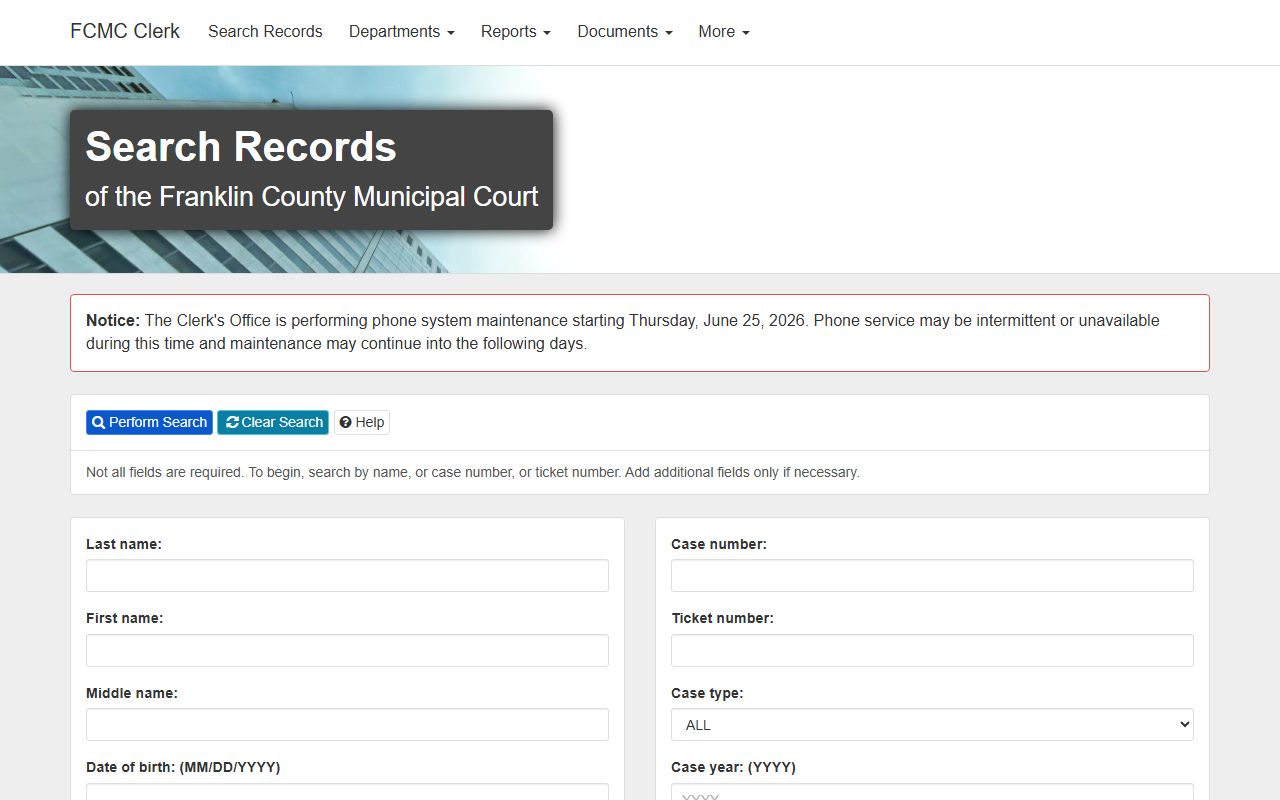
The search fields matter because a name-only search can return too many records, while a case number from the jail roster can lead straight to the matching charge record.
| Municipal Court Field | How It Helps After Arrest |
|---|---|
| First and last name | Required together for a name search, useful when no case number is known. |
| Date of birth | Optional narrowing field in MM/DD/YYYY format. |
| Case number | Often the fastest route when the sheriff roster or paperwork lists it. |
| Ticket number | Useful for traffic and citation-based criminal matters. |
| Case type and status | Can limit results to criminal/traffic and open, closed, jail, or other statuses. |
Franklin County Court Charging Documents
A jail arrest does not freeze the final charges. Booking charges are the custody-side description at intake. Court charges depend on the filing that reaches the clerk and court. The Franklin County Prosecuting Attorney prosecutes felony crimes, and the office's Criminal Division includes General Felony and Grand Jury functions. That role is important because a felony arrest may begin in Municipal Court but later become a Common Pleas case through indictment or bindover.
The Franklin County Prosecutor Criminal Division page explains felony and grand-jury work. When a case is presented for indictment, the docket may show a different set of counts than the first jail record.
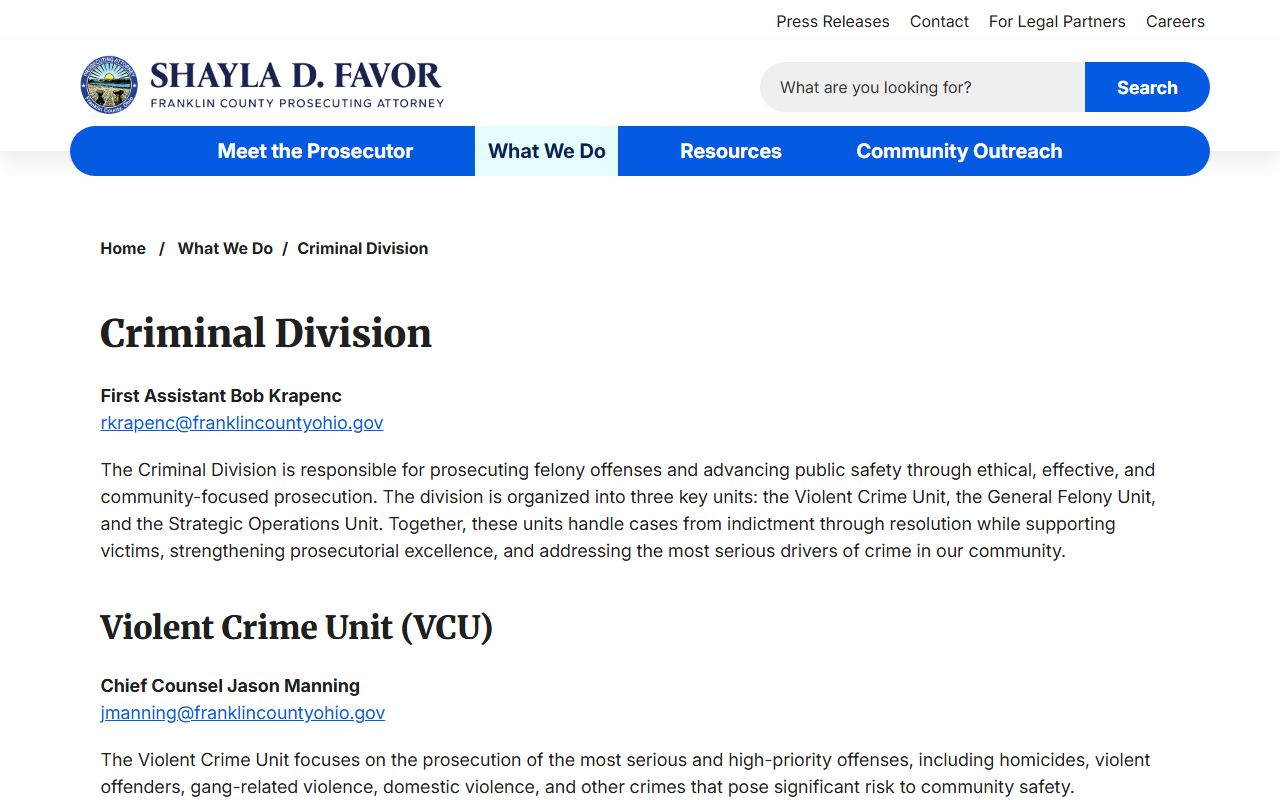
That prosecutor source is useful for understanding who pursues felony charges, but the filed case record still belongs in the clerk and court portals.
| Document | Who Uses It | What It Means |
|---|---|---|
| Complaint | Law enforcement, city prosecutor, or prosecutor | Common starting document for misdemeanor, traffic, and initial felony filing stages. |
| Information | Prosecutor | A formal prosecutor filing used when the law and case posture allow it. |
| Indictment | Grand jury and prosecutor | Formal felony charging document that can move a case into Common Pleas criminal court. |
Ohio Revised Code 2935.10 helps explain why arrest information must move toward formal criminal papers. The court record is the place to watch that shift.
Franklin County Court Charge Status
Charge status is the reason court records after a jail arrest should be checked more than once. A charge may be filed, amended, reduced, dismissed, bound over, indicted, or resolved by plea or trial. The sheriff roster may still show current custody information, but the court docket shows how each count is moving through the court system.
| Status | Plain Meaning | Why It Matters |
|---|---|---|
| Open or pending | The case or count has not reached final disposition. | Future hearing dates, bond terms, and warrants may still change. |
| Amended or reduced | The charge was changed from the first filed version. | The filed court count may differ from the booking charge. |
| Dismissed | The count or case was ended without a conviction on that count. | Dismissal is not the same as automatic record sealing. |
| Bound over | A felony moved from Municipal Court toward Common Pleas handling. | The next record may appear in CIO rather than only Municipal Court. |
| Closed | The docket marks the case closed. | Municipal Clerk help warns closed does not always mean fully completed or adjudicated. |
The Municipal Clerk daily arraignment report is another local source because it includes Courtroom 4D in-jail reports.
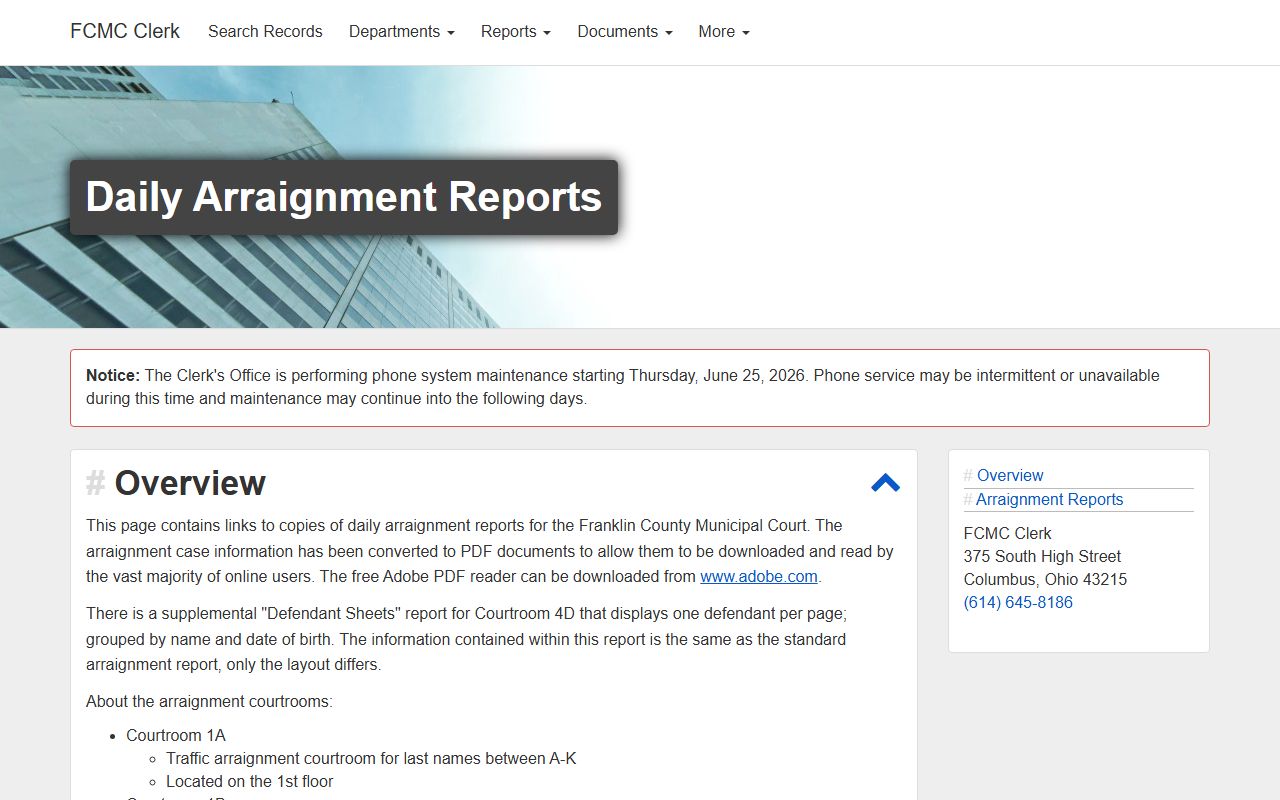
Daily arraignment information helps connect the first court appearance with the later docket, especially when the person is still in sheriff custody.
Franklin County Court Bond Records
The Franklin County Sheriff's Office gives a key warning on its inmate information page: bond information should still be obtained through the Clerk of Courts office. The jail roster can help find the person, current custody status, charges, case numbers, and court dates. It is not the final source for bond amount, bond modification, or payment rules.
| Bond or Hold Term | How It Works |
|---|---|
| Cash bond | Money is posted through the proper court or clerk process, subject to the exact docket entry. |
| Surety bond | A licensed surety or bail bond agent posts bond if the court permits it. |
| Personal recognizance | The person is released on a promise to appear and comply with conditions. |
| No-bond hold | Payment will not release the person because release is not authorized. |
| Detainer | Another agency or jurisdiction may keep the person in custody. |
Warrants need the same caution. The Franklin County Sheriff's wanted-persons page tells readers not to take action themselves and to contact law enforcement. The sheriff also warns that warrants should be verified before an arrest. Municipal Court search may show warrant status tied to a case, while Common Pleas CIO may show felony warrant activity after filing.
Franklin County Charges vs Convictions
An arrest and a charge are not a conviction. Franklin County court records after a jail arrest may show an accusation, a warrant, a bond order, or a pending count long before a final result. A conviction requires a guilty plea, verdict, or other final adjudication that supports conviction entry.
| Point | Charge | Conviction |
|---|---|---|
| Stage | Accusation or filed count | Final result after plea, trial, or qualifying finding |
| Proof | Based on filing standards and probable cause at early stages | Requires the legal proof or plea needed for conviction |
| Record meaning | Shows what was alleged or filed | Shows the person was legally found guilty or admitted guilt |
| Can change | May be amended, reduced, dismissed, or indicted differently | May later be appealed, sealed, or expunged if eligible |
Franklin County Sealed vs Expunged Records
Ohio law gives eligible people a route to ask the sentencing court to seal or expunge certain records. The main research source for this page is ORC 2953.32, which covers sealing or expungement of eligible conviction and bail-forfeiture records, subject to exclusions and waiting periods. A dismissal or eligible disposition can help, but no page should imply that a record disappears without a court order.
| Issue | Sealed | Expunged |
|---|---|---|
| Public access | Hidden from most public court searches after a valid order. | Removed or treated more strongly under the expungement order. |
| Where to file | With the court that has authority over the record. | With the court that has authority over the eligible record. |
| Limits | Eligibility, exclusions, and waiting periods apply. | Eligibility, exclusions, and waiting periods apply. |
| Effect on online data | Public portals may restrict access after processing. | Official record systems update according to the court order. |
Ohio Public Records Act access under ORC 149.43 is broad, but it does not override every sealing order, juvenile restriction, law-enforcement investigatory exemption, victim protection, medical privacy rule, or court rule. Juvenile records also have different access channels, and the Franklin County Clerk public-records request page notes that juvenile-record requests require Juvenile Division handling with valid picture ID.
Franklin County Court Record Limits
Casual court lookup is not the same as a lawful employment, tenant, insurance, credit, or licensing background screen. Ohio court portals and sheriff records can be incomplete, delayed, sealed, amended, or limited by public-records exemptions. A person checking Franklin County court records after an arrest should verify the final court file before treating a charge as a conviction.
Important: Franklin County Inmate Population is not a consumer reporting agency, and the information here may not be used for FCRA-covered screening.